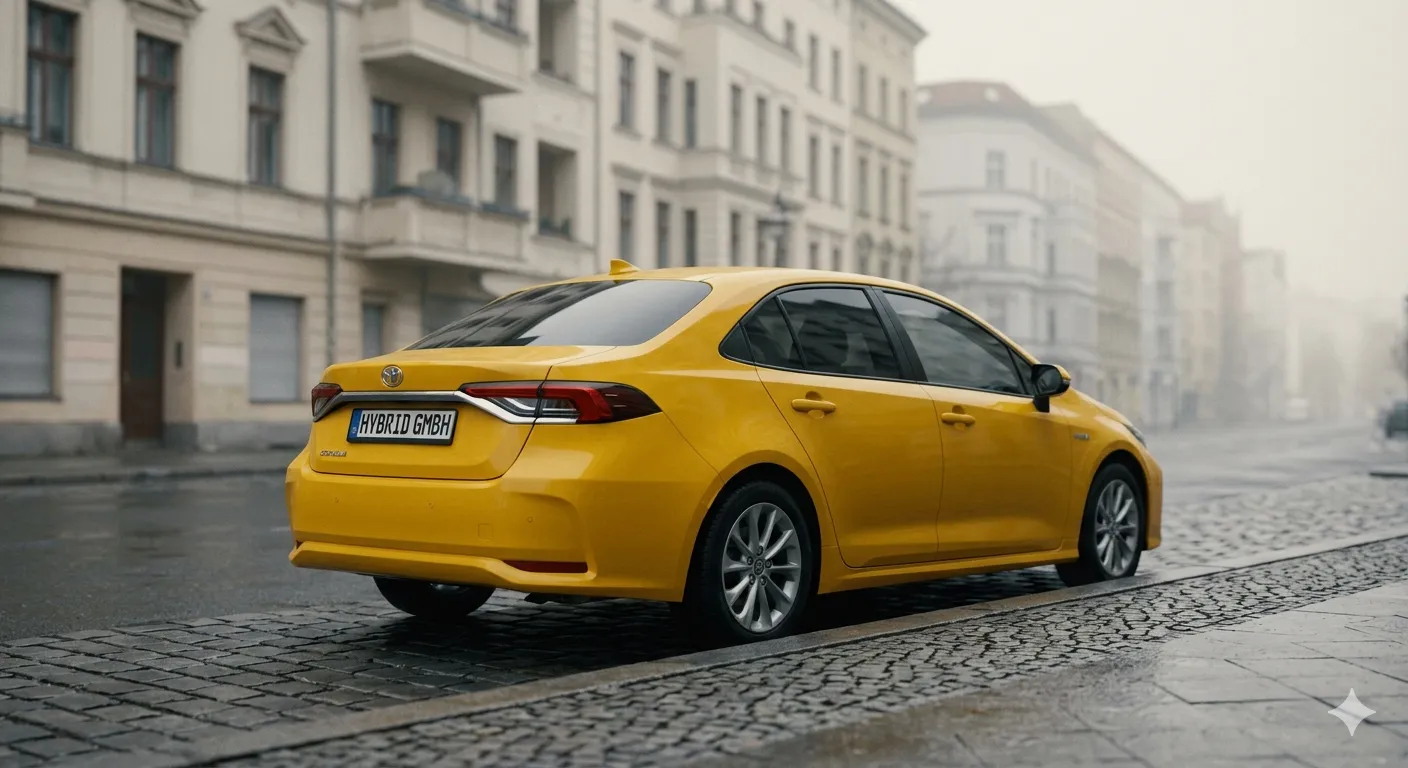
- Ordering a taxi to your address costs nothing extra. The drive to your door is free.
- Flagging one down only saves money under 2 km, and the €6 short-distance fare never applies at a rank or on a booking.
- App cars thin out late because private-hire vehicles have to return to base after every ride. The Bundesgerichtshof confirmed that rule on 3 June 2026.
- A fixed price instead of the meter is only available if you book ahead.
- At BER, the ranks sit in front of Terminal 1. Terminal 2 doesn't have one.
Searching "taxi near me" in Berlin gets you a list of companies on a map. That is not the same thing as a car on its way to you, and the difference matters most at the moments you care about: 5am with a suitcase, midnight in the rain, a hospital appointment you can't be late for. Here's how a car actually reaches you in this city, what each route costs, and which one to pick.
What does "taxi near me" actually get you in Berlin?
A list of businesses sorted by proximity, ranked by how well those businesses have filled in their map profiles. Proximity to a dispatch office tells you nothing useful, because the office isn't what picks you up. The car is, and the car is already somewhere else.
What gets a car to you is one of four things: a raised arm, a rank, a phone call, or a booking. Each behaves differently on price and on waiting time.
Is it cheaper to hail a taxi than to order one?
No, because the drive to your pickup address is free of charge. The meter starts when you get in, not when the driver sets off, so ordering a car to your building costs exactly the same as walking to the corner and waving at one.
There is one real exception, and it's worth knowing. The Kurzstrecke is a flat €6 for up to 2 km, and it only applies when you flag down a moving taxi from the street. Get in at a rank and it doesn't count. Order the car by phone or app and it doesn't count either.
So: under 2 km, on a street with traffic, hailing wins. Everywhere else the two cost the same, and ordering saves you standing outside.
Everything else runs on the meter. According to the Taxi-Innung Berlin, the tariff in force since 20 December 2022 is €4.30 to start, then €2.80/km up to 3 km, €2.60/km to 7 km, and €2.10/km after that. Fares inside the city are metered by law, and haggling over the price is not permitted.
Ranks, Rufsäulen and the taxi you can see but can't take
A taxi is available when the roof sign is lit. Unlit means occupied or off duty, and no amount of waving changes that.
Ranks are spread across the city, usually at stations, hospitals, hotels and larger junctions. Many carry a Rufsäule, a call column that reaches dispatch directly, which is useful when your phone is dead or you have no data.
The catch is that ranks are static and demand isn't. A rank that holds six cars at 11pm on a Wednesday can hold none at 2am on a Saturday, and the nearest one to you may be two streets in the wrong direction. Ranks are excellent when you're already standing at one. They're a poor plan when you aren't.
Three ways to get a car to you, and when each one wins
Call dispatch when you need a car now. A human takes the address, and if the address is complicated (a courtyard entrance, a building site, a hospital with four gates) you can say so out loud, which no app field lets you do properly.
Our own line at Hybrid Taxi GmbH runs 24 hours: +49 157 92524126. The three big Berlin dispatch centres take orders round the clock as well, and we publish their dispatch numbers in full, because someone who needs a car at 3am needs a car, not a sales page.
Use an app when you'd rather not talk, or when you want to watch the car approach on a map. Book in advance when the trip has a deadline attached: a flight, a train, a first appointment of the day. Advance booking is also the only route to a fixed price, which is the next section.
Fixed prices are the whole basis of how we quote. You see the fare before you confirm, there's no surge, and the number doesn't move while you sit in traffic on the A100.
Uber supply thins out noticeably in Berlin at night. Why that happens, and what works instead, is in our taxi, Uber and Bolt comparison.
You can agree a price before the ride instead of watching the meter. The conditions are on our fixed price taxi page.
BER has its own rules for pickup and pricing. Terminals, waiting zones and fixed fares are on our Berlin airport transfer page.
When the car near you isn't the car that arrives
Book with a flight number and the tracking runs on our side, not yours. When a schedule shifts, our system picks it up automatically and a dispatcher calls you to confirm the new pickup time. The detection is automated so nothing is missed at 04:00; the decision stays with a person.
At arrivals the driver holds a name sign, so the pickup doesn't depend on your phone working, and we take a second contact number when you book: a travel companion, your hotel, whoever made the reservation. The driver waits up to 60 minutes and we absorb that cost.
Our dispatch rule is that drivers should be at the airport at least 20 minutes before the flight lands, waiting in the BER parking area. That leaves a pool of cars already on site with slack in them, so when a car fails on the way to an airport pickup, the job goes to a driver who is already at the terminal and the city car backfills the gap. The original driver messages you on WhatsApp to explain and apologise before the replacement pulls up. It works because our salaried drivers are paid to sit in a car park doing nothing, which a commission driver has no reason to do.
What's the fastest way to get a taxi near me right now?
Call. A phone call skips the app queue, handles awkward addresses in one sentence, and reaches a dispatcher who knows which streets are shut this week.
If the trip has a deadline on it, book instead of searching. We've run Berlin taxis since 2008, across all 12 districts, 24 hours a day, and our dispatch line is open whether you need a car in 10 minutes or on Thursday at 4am.